
Review
Time for a Menthor
CHOO CHUN HOE explores a local amplifier and discovers how to get the most for less than a grand. Time to pop a MenthorGETTING a great sounding integrated amplifier for less than RM1,000 is easy. However, most of them come in flimsy casings with little attention paid to looks. Understandably, at this price, manufacturers have to compromise because the chassis can easily take up a big chunk of the cost. It's often said that the money is better spent on parts affecting the sound.
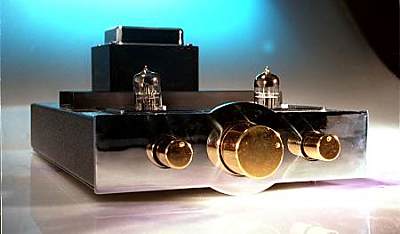
The good news is that local tube amplifier manufacturer Rolling Beat has introduced an alternative to the usual boring black box that you get for the price. The RM899 Menthor Integra, the company's entry-level hybrid amplifier, is something that will cause audiophiles to drool.
Ironically, the amp wasn't conceived for audiophiles. According to one of the designers, Choo Teck Chee (not related to me), the Integra was intended for "normal people" looking for an affordable, nice looking amplifier that also complemented their house decor.
"Apart from sound quality, we also placed a lot of attention on the look of our amplifiers," Choo added.
Features
The attention to aesthetics can be seen from the Integra's four gold-plated inputs, two pre-outs and the three knobs, comprising selector, power and volume, in 24k gold plating! Housed in a sturdy casing, the preamp stage uses a pair of 12AU7 tubes while the power output--using solid-state circuitry--is 25 watts.
Choo recommends using the Integra with speakers rated at 86dB and above. The unit does not come with any feet. Instead, three metal cone feet are supplied and these you can substitute with better ones when upgrading.
Performance
The Sharma SHF-260 integrated amplifier was the main amplifier used for comparison. I later used the Integra as a preamp with the B&K CS-117 and the passive Cello Etude as a reference while power amp was the Bryston 4BST. A Musical Fidelity Tempest amplifier was also briefly employed.
CD player was Sony CDP-X707ES and speakers included Sonus faber Minima and Acoustic Energy AE100. Cables comprised Kimber Kable 8TC and AudioQuest Indigo while interconnects were Kimber PBJ and Silver Streak. The Integra was plugged in with an AudioQuest power cord.
The Integra has an ability to imbue music with an appealing, silky touch without sacrificing detail in the process. It is also quite gentle, helping to give music a relaxed feel, although there is a prevailing tinge of brightness. Next to it, the Tempest appeared thin, sterile and coarse. During the review session, the Integra was never irritating and provided a very enjoyable listen.
Despite its polite nature, the Integra was not slow to the point of being lethargic. In fact, it proved to be quite a gutsy little amp, being able to drive the insensitive 84dB-Minima to moderate volume without breaking up.
At the same time, if you want to shake walls and rattle windows this wouldn't be the amp for the job.
The Integra is about making all types of music pleasant to listen to. Purists may argue that its euphonic nature colours the sound, but I don't see this as a problem, as some very pricey amplifiers also share such a character.
As a preamp, I discovered that the pre-out is not just a gimmick. It produced a very clear soundstage with well-defined images plus a good sense of surrounding air. Unfortunately, it was bugged with limited bass extension and a rolled-off treble, but there was little to complain of considering the price. Although it never came close to the Cello preamp, the Integra is clearly superior to my vintage and pricier solid-state B&K CS-117. The B&K was more opaque with a lesser "see-through" quality.
A mini shoot-out was later conducted with another locally made amplifier, the Sharma SHF-260. A 60-watt solid-state design, this RM299 wonder, when suitably partnered, gave some well-known American high-end muscle amps a run for the money with its exuberance and exciting display of fast, gripping bass lines.
The results showed that the Integra's bass had less focus, slower, not as well separated and did not go as deep. The lack of bass extension that was evident when used as a preamp was still apparent even through mini-monitors. However, the low frequencies had a sense of bloom to give it some weight.
Not surprisingly, the Sharma exhibited a much deeper, tighter, responsive and propulsive bass. Music sounded bigger, more effortless and rhythmic. However, the treble was rougher and the overall presentation was more veiled. Vocals were more diffused and murky, as if they were singing through a thin cloth over their mouths.
Through the Integra, the vocals were clearer and more expressive. The amp was also more graceful and revealing, with more subtleties of the music coming through. The air or sense of space around various instruments was also better captured, helping to convey music with better presence.
Conclusion
You will most probably be wondering which amplifier is worth buying after reading the shoot-out. Apart from the price difference, these two amplifiers are a big contrast from each other in terms of music interpretation.
Judging by sound quality alone, there is no clear advantage of one over the other. The Sharma can drive more speakers and excels with its fast, articulate bass coupled to a lively character. However, it is encased in a fragile, bland looking black box and is no joy to look at. It also lacks the versatility of the Integra's impressive pre-outs.
The Integra, on the contrary, sounds more lifelike and its finish exudes an air of elegance that is noticeably missing from other amplifiers of that price range. Its classy looks plus sweet-sounding nature will help it to blend into most home decors and affordable systems unobtrusively.
Despite the drawbacks, it did not significantly prevent me from enjoying music. It is a bargain, especially now.
Model: Menthor Integra integrated amplifier
Price: RM899
Review sample courtesy of CHOO MUSIC SHACK / ROLLING BEAT (03-795-7179), 81 Jalan 1/12, 46000 Petaling Jaya, Selangor.
For: Well finished for the price; small; sweet sounding; preamp section has impressive clarity for the money.
Against: Limited bandwidth; not much bass extension.
AudioFile © 1998, Star Publications (Malaysia) Berhad (No. 10894-D).
All rights reserved.